Following Universität der Künste Berlin’s 2021 graduate show, we spoke to scientist-turned-fashion designer Alessandro Gentile about his final collection and post-graduation plans
Raised in Trieste, a city perched on Italy’s Adriatic coastline, Alessandro Gentile’s path to becoming a fashion designer was far from usual. His fascination with technology and the sciences, sparked in his formative years, led him to enrol at a local school specialising in Biology and Healthcare.
Although he found the course academically enriching, shortly after completing his studies at 19, Gentile began to question whether the sector aligned with his ‘more creative inclinations’. Committed to broadening his perspective, he packed his bags and booked a one-way ticket to Berlin. The city’s raw energy and subcultural vibrancy immediately resonated with his heavy-metal sensibilities and spike-studded personal style.
What began as a spontaneous venture soon evolved into a lasting love affair with Berlin’s freedom of expression and diverse fashion scene. Driven by a growing curiosity to learn more about society and work with his hands, Gentile applied for the BA Fashion Design programme at Berlin’s renowned art and design institution, Universität der Künste (UdK).
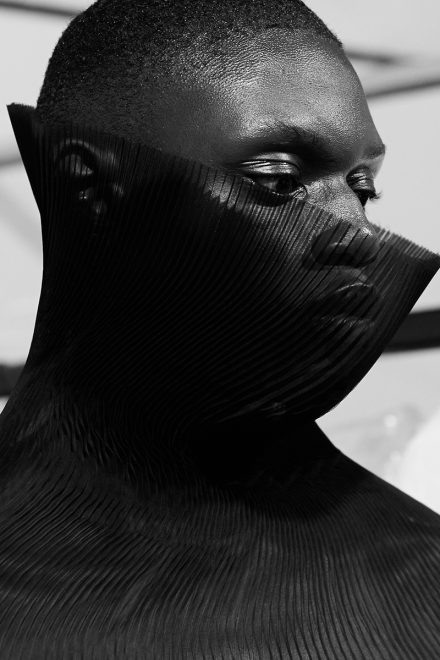
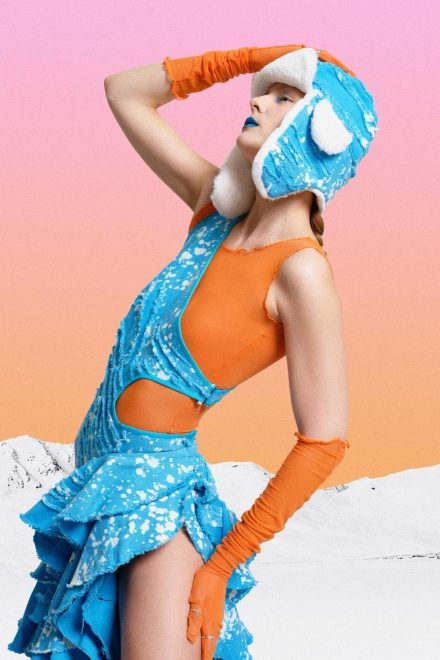
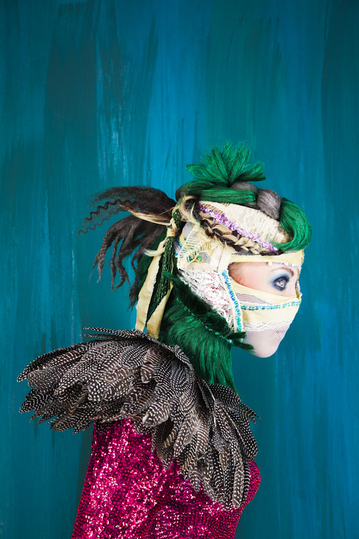
On 30 October, the university hosted Freewheeling, its 2021 graduate fashion show, where Gentile presented his final collection, Select Masculinity. Melding 19th-century military tailoring with cyber-futuristic materials, he dissected the notion of ‘toxic masculinity’ and explored how social constructs shape gender identity.
Moved by the intellectual depth and sculptural precision behind the garments, we sat down with Gentile over a well-deserved pizza to discuss his creative evolution, final collection, and post-graduation plans.


From a science-focused education in Trieste to cutting fabrics at UdK, your journey to becoming a fashion designer is pretty unconventional. What influenced this transition?
After finishing school in Trieste, I honestly had no idea what to do next. I decided to move to Berlin, hoping a change of environment would grant me new experiences and broaden my worldview. Once there, I began immersing myself in the city’s subcultures, and that’s when the idea of studying fashion design began to take shape — though it was far from an obvious choice at the time.
As a teenager, I actually despised fashion and the people I thought represented it. However, paradoxically, I was very concerned about my appearance. I used to customise my clothes, or have my dad, who is a leather goods manufacturer, customise them for me. I was deeply enmeshed in the heavy metal community — I played guitar in a band, and my look reflected this: spikes, chains, leather, and heavy boots. It was the complete opposite of what ‘fashion’ meant in Italy at the time.
Berlin changed that perspective. The city showed me how richly diverse and expressive fashion could be — that it wasn’t about blind conformity. There will always be a space or community for you to celebrate your identity. That realisation made me curious to learn more about society and myself. I knew I wanted to do something creative and work with my hands, which is how I ended up applying to UdK.
Besides Berlin’s fizzing subcultural scene, what tends to ignite your creativity most?
Contradictions that exist in our society. They always seem to lure me into my analytical mindset, which inspires me most to create. There are so many things we accept as facts, yet they often exist only because of the context of a particular time or culture. Understanding these contradictions helps me appreciate differences between people and ideas, and I think that kind of understanding is also what drives creative growth.

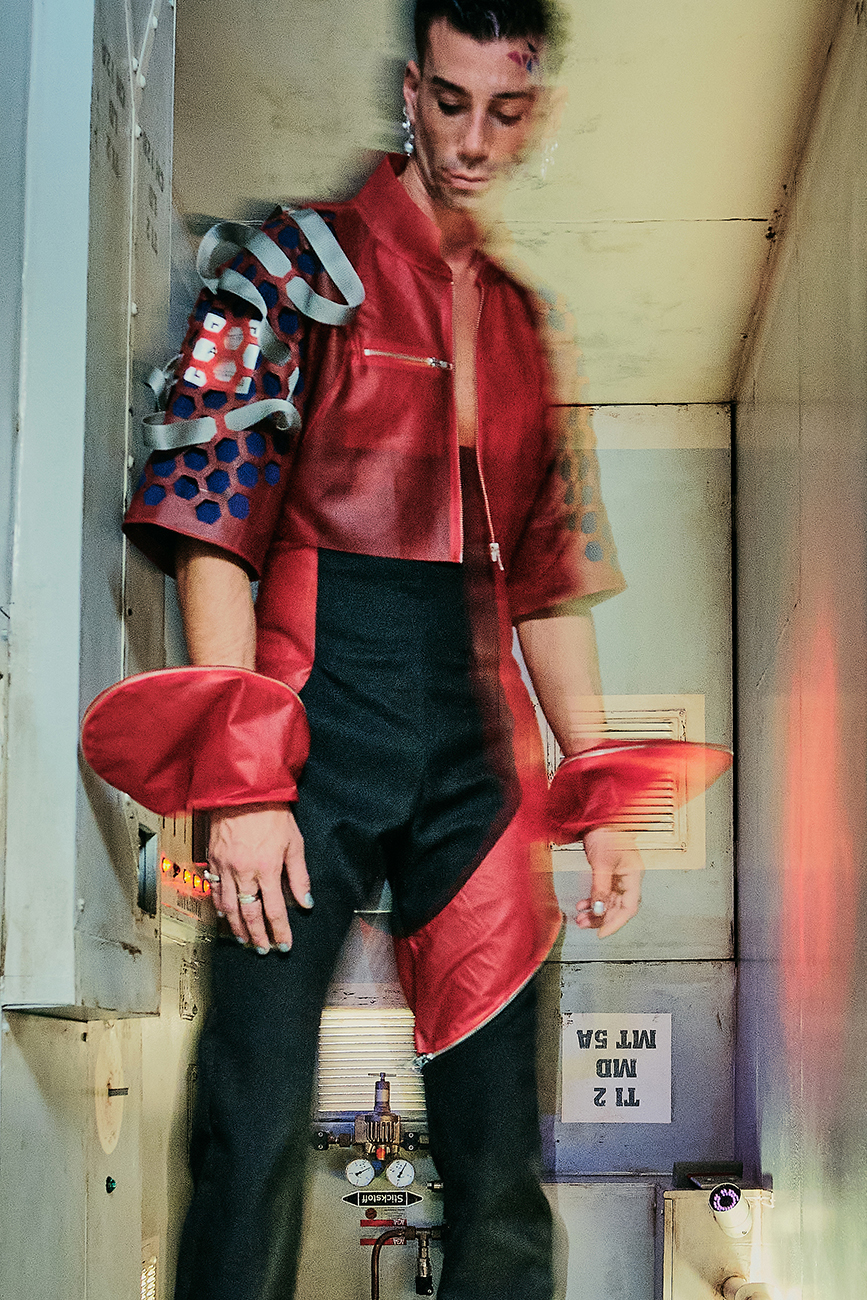
Your graduate collection, Select Masculinity, evinces your efforts to dissect social constructs and contradictions surrounding gender and identity. How did you go about translating complex narratives into clothing?
With my final collection, I explored how toxic masculinity manifests across fashion, video games, and the military — three fields that often glorify hyper-masculine ideals. Each has its own way of constructing and enforcing what a ‘real man’ should look or act like. I wanted to deconstruct that and expose its contradictions.
Even when someone recognises their own toxic traits, it’s not easy to unlearn them. You can stop being harmful, but it’s impossible to erase every part of yourself. I believe repression isn’t the answer — instead, we need to give those impulses space, analyse them, and transform them into something positive. My collection created a space for that process.
I worked with design elements that symbolise traditional masculinity and turned them on their head. For instance, I reinterpreted 19th-century military uniforms — corsets, tight cuts, and golden embroidery — which were once criticised for being too effeminate. I combined those references with the cyber-futuristic aesthetic of video games, where hyper-masculine heroes have robotic limbs and seemingly limitless power.
Using laser-cut fluorescent acrylic glass engraved with digital camouflage, I constructed sculptural shapes and layered them with hand-stitched macramé embroidery, blending aggression, fragility, and precision. It’s about showing that masculinity isn’t fixed; it’s fluid, constructed, and open to change.
Compared to most designers we speak to, who lead with emotion and personal experience, your scientific background really shines through in your methodical, research-driven approach to conceptualising a collection. How significant are these more ‘humanistic’ elements in your process?
(Gentile laughs.) Yes, I definitely have a more scientific and experiment-driven approach when conceptualising and producing my creative work. But for me, design is as much about feeling as it is about theory. My ideas often come from personal experiences — from trying to understand myself and the people around me. I like to analyse, but I also like to build intuitively. Fashion, at its best, allows those two worlds to coexist.


In addition to your scientific training and methodical approach, what do you think sets you apart from other designers?
That’s always a tough question. I can’t really prove that my ideas are unique, but people often tell me that my work feels personal. I don’t follow trends; I only design what I need or want to say in the moment, which keeps my work authentic. So I guess you could say honesty is part of my signature. I’m sure there are many other authentic designers, but that’s a special feeling I want to maintain in my work.
Now that you’ve completed your course at UdK, what are your post-graduation plans?
I’m planning to pursue a master’s degree in 3D digital fashion to explore Augmented and Virtual Reality. I think this field has huge potential — it’s redefining how we create, experience, and consume fashion. At UdK, I developed strong handcrafting skills, so I’m now keen to balance that with digital innovation techniques. But first, I’d like to gain more work experience and, of course, save a bit of money (Gentile laughs).


Credits
WORDS
Lucy Rowan
Fashion
Alessandro Gentile
Photography
Marco Lombardi
Make-up
Elisa Sankowski
ModeLS
Niklas Jeroch,
Emanuele Corsini,
Alessandro Gentile, and
Timo Thomalla (Faze Models)