Following his three-month residency at Amsterdam’s cultural space, we caught up with the multidisciplinary artist to discuss his first solo exhibition and capsule collection
Spanning clothing design, sculpture and large-scale installation, Aron Saxe’s practice recasts materials into vessels that echo unvarnished human stories. Moulded as much by Amsterdam’s underground music scene as by formal training in fashion textiles, the British designer has spent several years crafting bespoke garments for private clients — namely Peach, Call Super and Shanti Celeste — cultivating a mystique on dancefloors with no-phone policies.
From October to December, Saxe participated in Club Raum’s artist residency programme, piloted in 2025 in partnership with the Amsterdam Fund for the Arts and the party Spielraum. The Amsterdam-based programme embeds artists within the social and cultural rhythms of the club, positioning nightlife as a vital site of creative expression while offering funding, mentorship, and production support.
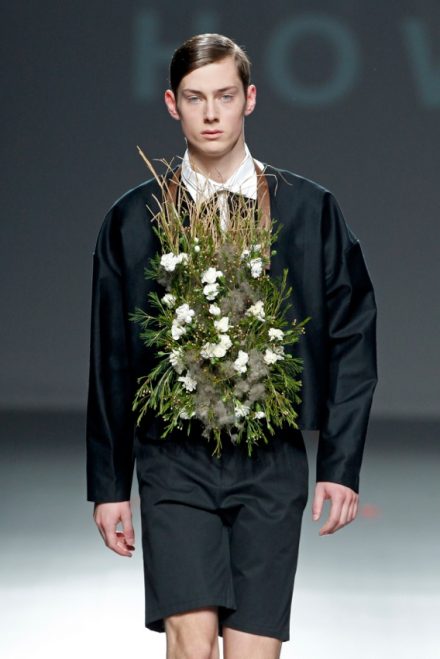
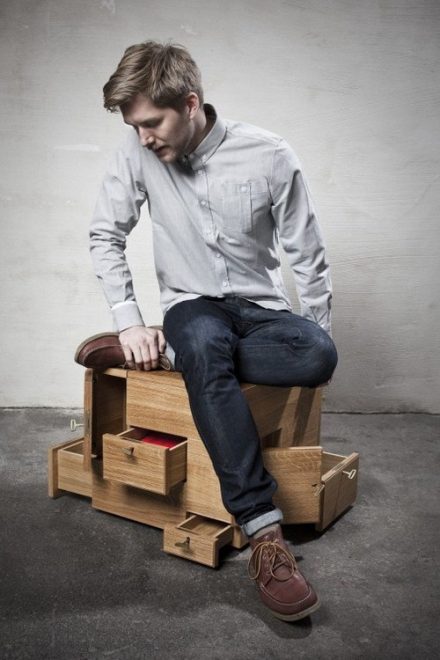
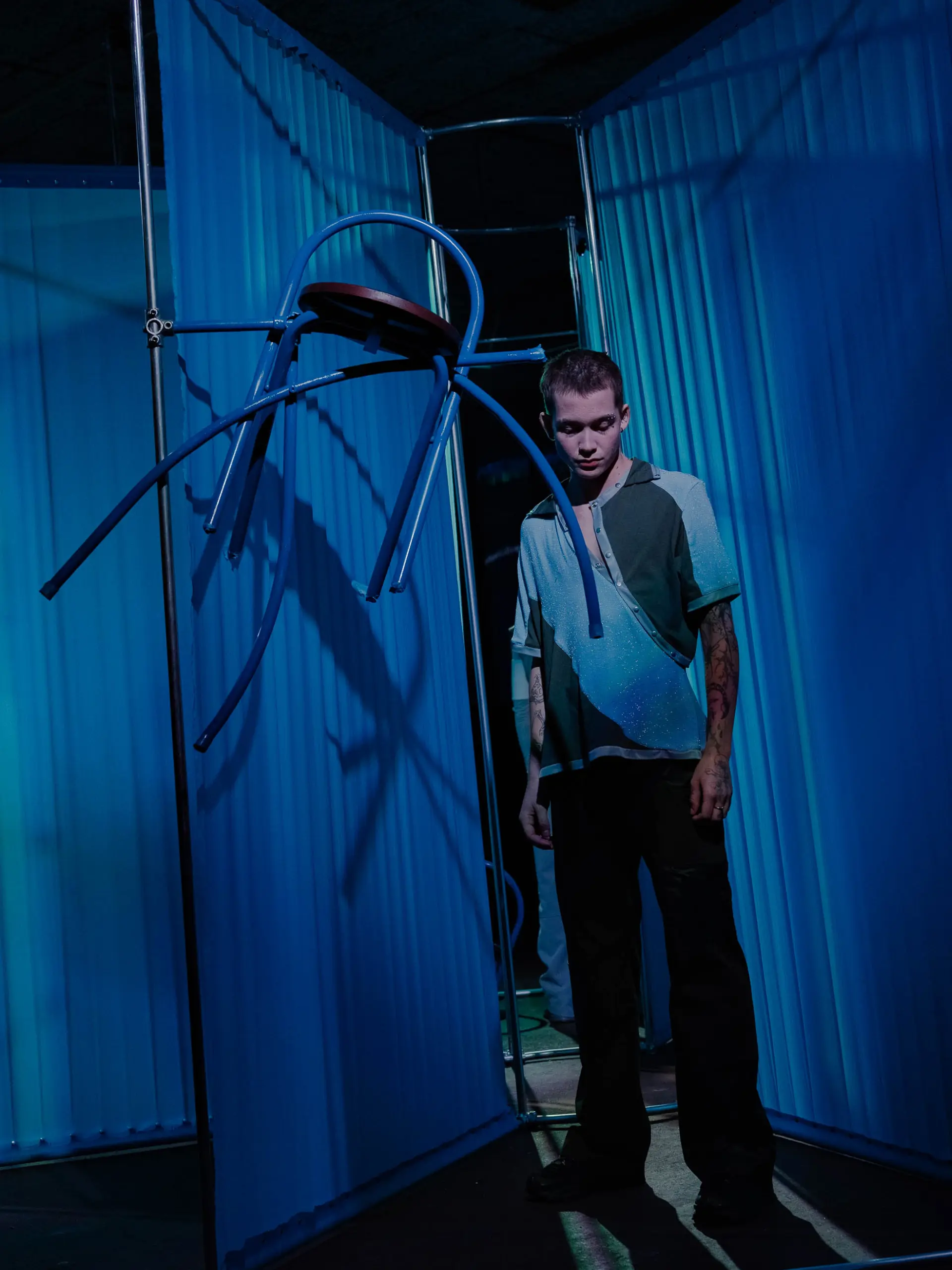
On 12 December, Saxe unveiled his first solo exhibition and capsule collection, you might need to sit for this (2025), at the queer-run venue. Defying traditional fashion show conventions, the event unfolded as a collective encounter — intimate, emotionally charged, and rooted in lived experience. At a time when trans lives are increasingly politicised, misrepresented, and under threat, Saxe’s work resists spectacle in favour of care, trust, and recognition.
Elaborating on why the project resonated with Club Raum, Art Programmer Lucia Fernandez Santoro said: “Working closely with six trans men, Saxe translated their personal narratives of transition into a public presentation comprising a fashion collection and an installation, in which participants served as models. His work exemplifies the residency’s focus on nightlife as a platform for cultural production, using the dancefloor to amplify underrepresented voices.”


Looking back on your formative years, when did fashion first become part of your creative vocabulary — and how did that shift take place?
I grew up on the outskirts of London in the 1990s and early 2000s, in a very grey, ‘nothingy’ suburb called Chessington. With little to do and few resources at home, my older sister and I spent hours drawing characters — carefully cutting them out and developing storylines for them. I was particularly fascinated by how clothing carried meaning, materialising each character’s identity.
Despite the monotony of my surroundings, the train station offered a gateway. I learnt to cut and paste dates on travel cards, giving me an endless freedom pass. From age 11, I spent all my free time in central London — first Camden, later Soho Square — gradually becoming more immersed in music and style. I was compelled to ignore the advice and completed a BA in Fashion Textiles at the London College of Fashion. I already knew my practice was hard to categorise and needed room to blur the edges; textiles offered that freedom.
After graduating, London offered little more than unpaid internships. Amsterdam promised a paid design role at Calvin Klein, where I spent three years gaining insight into the corporate mechanics of the fashion industry. In hindsight, I needed to experience design stripped of storytelling to realise how essential narrative is in my work. Ultimately, what I do is about people, not products.
Your practice encompasses sculpture, installation and clothing design. How do these disciplines typically converge in your projects?
I approach them as distinct yet interconnected practices. I make sculpture, but my clothing isn’t overtly sculptural — I’m not a textile designer who makes lumpy things. Instead, I unite all three forms to create something immersive, a ‘world-building’ so to speak — fleshing out the stories behind the people I’m collaborating with.
My Club Raum residency was the first opportunity I’ve had to conceive installation and fashion as one organism from the outset. The research workshops themselves became a form of custom-making — not based solely on measurements or preferences, but on insights into the participants’ inner world. That shift fundamentally changed the work.
My previous work focused heavily on research into astrobotany and planetary science, constructing speculative environments where alien plant life engulfed human elements. Fantasy functioned as a form of escape. With my most recent project, that approach was inverted. Instead of looking outward, the project became an in-depth investigation of the trans body, identity and experience.

Congratulations on your first solo exhibition and capsule collection! Can you talk us through the concept and how the work came together?
For my final residency project, you might need to sit for this (2025), I worked directly with six trans men from the research phase, which consisted of a series of writing workshops. Their experiences and emotions were translated into clothing, space, sculpture, and movement. The research workshops explored how a chosen memory is embodied, producing rich, layered documents that piece together mind, body, and heart at a specific moment in transition.
Through poetry, movement and deep reflection, these portraits of trans masculinity provided a wealth of input for the collection and the exhibition as a whole. Each piece responds to themes unique to each participant: a muddle of feelings, a distinct moment in their transition, and a sense of self that differs from one person to another. The participants also performed in the show itself, offering a sensitive insight into an often unseen trans masculine experience.
This is the first fashion collection where I’ve had the resources and time to make work since university. I designed, patterned, and constructed everything myself inside the nightclub, often working late into the night, sewing sleeves as the smoke machine filled the room, stopping only when the lights needed to be turned off for the party to begin. We created a community where we so often struggle to find one another. It was a very healing experience for me as well.
How did these individual stories of transition influence your material, colour and form choices?
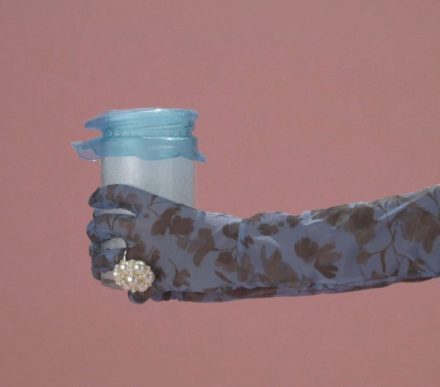
To truly respect privacy, I can’t detail the direct inspirations too much, but the broader, most common narrative among all participants was a sense of being at odds – a conflict between perception and lived reality. Colour plays a huge role in how I communicate emotion. The palette used for this collection is intentionally insipid — pleasant, but not joyful. Overly palatable neutrals and a hospital blue come together in a slightly unsettling, clinical way.
Medical references are embedded throughout the collection as quiet signals for those familiar with the transition experience. Binding tape across the chest, hook-and-eye closures, and compressive materials all reference post-surgical garments. Sheer layers expose vulnerability, while heavily padded pieces suggest both protection and barrier. Other garments allude to life vests, parachutes, or helmets, signalling a determination to keep moving forward.


How was the exhibition received, and do you see yourself pursuing similar projects in the future?
On the day of the exhibition, a 17-year-old trans boy emailed me to ask if he could attend. Knowing the work reached him really reinforced why this project was so important for me to make. I was creating something I needed once, but couldn’t find. This shouldn’t be a solitary struggle. I hope the work can continue to find those who see themselves reflected in it.
I see real potential for more performances. The brotherhood built through working together with this group, with all their individual talents, will hopefully uplift us all as we continue to collaborate and expand upon this. Although it’s positive that the wider public gained a better understanding of the trans experience, it was never my core goal.
For future iterations, I’d love to work with dancer and choreographer Arad Inbar again — his direction elevated the storytelling elements. I’m also incredibly grateful to the artists who documented the performance. Aitan Ebrahimof’s film captures the raw emotional intensity, Tengbeh Kamara’s portraits breathe life into the exhibition, and Danii Walton’s behind-the-scenes coverage beautifully reflects the brotherhood formed.
At a time of heightened hostility, what role can fashion play in addressing the challenges facing the trans community today?
In a very simplified sense, fashion is a place where we can still dream. As a child designing outfits for paper people, I didn’t know what a trans man was, but I could imagine myself as a boy — even if the industry and society at large didn’t reflect that image to me. Trans men remain deeply underrepresented across all media, so fashion can play a pivotal role in shaping what is seen as aspirational.
Seeing examples of trans men in a glamorous light is simply great PR, if nothing else. But in these increasingly dangerous, conservative times, we can — and should — use music, art and fashion as vehicles of change. Only casting trans men in my show wasn’t an empty attention-grabbing statement; it came from a desire to find each other. Before building visibility, my own community needs to recognise and trust my work.

How did you initially hear about the programme, and what prompted you to apply?
I first heard about the programme through an open call posted online. Before the pandemic, I regularly worked in club spaces building installations with my close friend and collaborator, Marlyn Kist de Ruijter. Over the years, we created multiple evolutions of synthetic staged environments at De School in Amsterdam, which also had a strong art programme within a nightlife context.
For his annual December Weekenders, Call Super commissioned us to create installation works. Being granted full creative freedom taught me how to develop work under intense time pressure and experiment with unfamiliar materials. Introducing the variable of an intoxicated, interactive audience was a baptism of fire, but it gave me a solid grounding for my Club Raum residency. Having grown up within queer dance music culture, applying felt like a natural progression.
Reflecting on your time at Club Raum, what were the most poignant moments of the residency, and how have they guided your practice?
Club Raum’s support was such a gift. The residency offered funding, time and space — allowing me to take myself seriously as an artist, given the time I was granted to dedicate to research. As working-class or underprivileged creatives, we often don’t get the platforms to show our potential to the outside world — and even more importantly, to ourselves. It allowed me to realise my capabilities as a designer.
Looking back on the residency, I seem to have created a very elaborate way to force myself to sit with my own transition experience. As trans people, we have had to look at ourselves deeply — and often — to get where we are, which can come with a painful amount of self-awareness and critical thought projected back onto us from society. Watching how tenderly I worked with others’ emotions allowed me to process my own without self-judgement. I’m very proud of the outcome — and the relationships fostered throughout.


Given that shift in confidence, are you considering expanding beyond custom commissions or rethinking your label’s production model?
Seeing my work as a ‘label’ has always been difficult. Changing my government name wasn’t the most business-minded decision, but it was one I needed to make for myself. Beyond that, the rigidity of the fashion calendar — and the expectation on independent brands to constantly produce newness to stay ahead of the ‘Sheins’ — has honestly been intimidating.
Custom sits at the heart of what I do because I’m nourished by character study, and I’m lucky to work with very interesting clients. That said, this way of working doesn’t have to remain custom-only. Moving forward, my goal is to distil the characters and storylines I’m developing into a small number of ready-to-wear pieces per season. Presenting this collection under my new name feels like a moment I can emerge from — now knowing exactly what I can offer.
What’s next on the horizon for 2026?
I’m still catching my breath and gearing up for what’s coming next, but I’m excited. Running a small label means I can shape how I work, and while I’m not yet tied to the fashion seasonal calendar, I want to enjoy the creative freedom that comes with that. I aim to celebrate, document, and archive the project more, hopefully reaching a wider audience with a continued focus on storytelling, photoshoots, and events that shape the world-building of my label.
The exhibition will remain open until mid-March at Club Raum, so I want to do something special to mark the closing. I’ll let the pieces settle to see where this project could take me next. I also need to return to custom orders and sewing ready-to-wear garments in the studio. Later this spring, when the ready-to-wear pieces are released, I’ll also launch my website and online store. Until then, you can reach me at aron.saxe@gmail.com to dream together.
Credits
WORDS
Lucy Rowan
fashioN & INSTALLATION
Aron Saxe
Photography
Tengbeh Kamara
FILMMAKING
Aitan Ebrahimoff
HAIR
Amanda Bom-Fritz
MAKE-UP
Youssef Ahmed Houda
Art Programming
Lucia Fernandez Santoro
Movement Direction
Arad Inbar
PRODUCTION
Alfredo Pontes
Production AssistanCe
Barros
Participants
Ash, Jason, Jay,
Mika, León and Pascale
SPECIAL THANKS TO
Club Raum