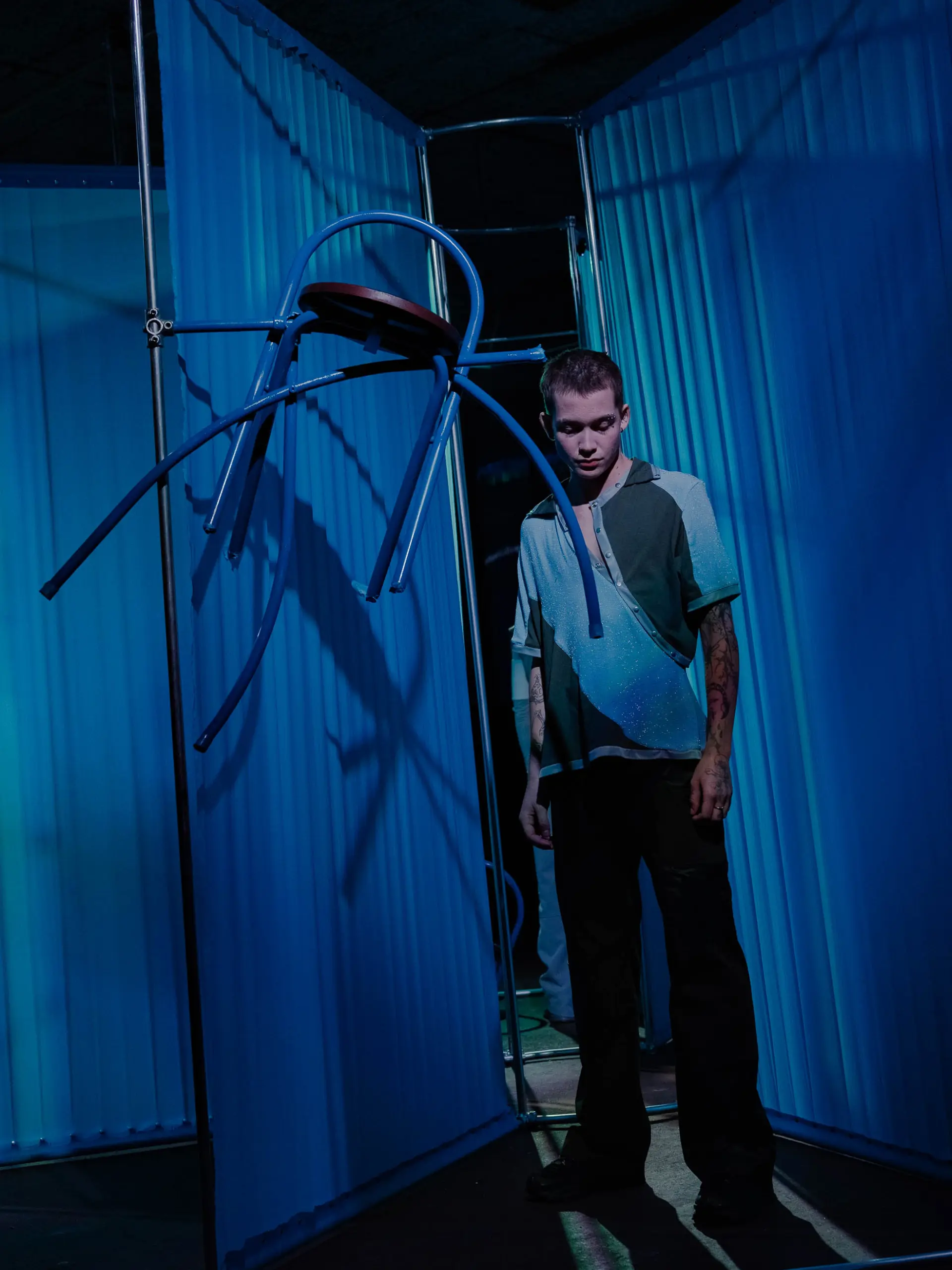
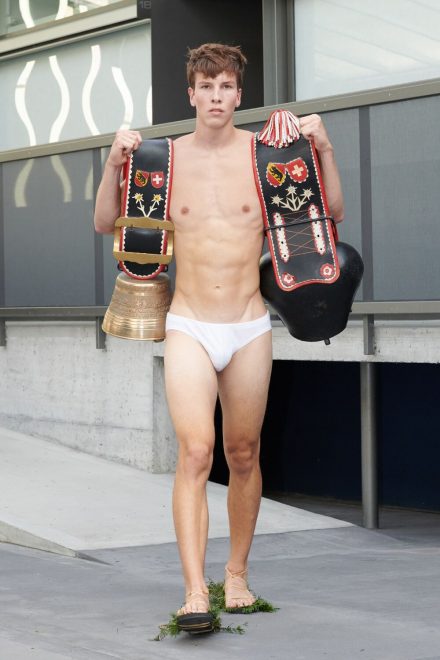
We spoke to multidisciplinary artist Seba Stolarczyk, founder of House of Base, about his latest collection and creative life in post-pandemic Berlin
Raised in the suburbs of Paris, multidisciplinary artist Seba Stolarczyk founded his Berlin-based label, House of Base, in 2013. Grounded in values of sustainability and social awareness, every piece is crafted on demand from deadstock fabrics and reclaimed materials, with a strong emphasis on inclusivity and community-driven design.
In recent years, Stolarczyk has turned his focus to releasing music under his pseudonym, Seba, a project he describes as running parallel to his fashion practice, with each discipline informing and inspiring the other. What began as a creative outlet, producing everything from one-off garments to full collections, has since evolved into a dynamic artistic platform. Accordingly, House of Base’s ethos has been reworked to include empowering individuals and supporting those in need through thoughtful, collaborative projects.
As additions to the latest collection, Faute Couture, become available online this year, part of the proceeds will be donated to ORAM, an organisation dedicated to protecting and empowering LGBTIQ asylum seekers and refugees worldwide, and to fostering long-term sustainability and systemic change. In the accompanying editorial images, you may recognise Cem Dukkha, the Viennese-born experimental musician and co-founder of Berlin’s notorious techno collective, Herrensauna.
Keen to learn more, we caught up with Stolarczyk to discuss Faute Couture, the realities of creative life in post-pandemic Berlin, and the ever-evolving landscape of independent artistry.
BELOW
Shoot 1 – See full credits at the bottom


Could you start by telling us more about the concept behind House of Base?
My approach to fashion is deeply rooted in youth culture. I love referencing, and paying tribute to, the subcultures, eras, and aesthetics that shaped our generation. For a long time, House of Base has been an open canvas for experimentation, evolving through various mediums and non-conformist expressions.
It began with the idea of representing a different kind of youth — daring, unique, and unapologetic — from all backgrounds, shapes, sizes, and identities. From the very start, it was important to create a space where people could feel empowered and liberated through clothing, where they could express themselves boldly. It’s that intersection between real life and the music videos we grew up watching.
If you had to name your greatest source of inspiration, what would it be?
Pop culture, always.
The collection featured in this article, Faute Couture, perfectly encapsulates the essence of pop and youth culture. What were you hoping to achieve with it?
With this collection, I wanted to reconnect with the roots of House of Base — to return to streetwear, and inject a sense of fun and individuality. Each piece needed to make a statement while remaining cool and comfortable — almost like a post-pandemic celebration of self-expression.
The process was organic and spontaneous, reflecting different aspects of daily life. I wanted to preserve that dreamy, carefree energy while adding practical, refined details. The silhouettes are loose and expressive, and most pieces are filled with pockets — so you can carry your whole life with you, just in case the end of the world comes.
How does your design process typically begin?
Everything starts with my desire to exaggerate reality — to take an everyday silhouette and amplify it into something striking and expressive. Each collection follows its own theme and direction, but the core inspiration stays consistent: street style, informed by the suburbs of Paris where I grew up, and the cosmopolitan energy of Berlin that surrounds me now.
My research often begins with images, textures, and materials, which help me connect different cultural and aesthetic worlds. Much like diverse communities that coexist and influence one another, I like to bring that same eclectic spirit into my work.
Alongside fashion, you’re delving more into music and video. When did you start working with these art forms?
I’ve always been passionate about music and video — writing, performing, and storytelling have been part of me since childhood. I wanted to be one of the Spice Girls — which obviously didn’t happen — but that spirit never left. During the pandemic, I felt the need to finally release something personal, something I could be proud of. That led me to collaborate with talented friends and build this parallel creative world.
So far, I’ve released several music videos and songs, including an EP called RIP Daddy — a collection of tracks exploring experiences, love stories, and fantasies, which was released in June. Creating outside of fashion, purely for myself, has been liberating. It’s exciting to perform under an alter ego and explore new ways of expression. I’ll be performing the project live at Club Visage in Paris on 19 February.

LEFT/ABOVE
Shoot 1 – See full credits at the bottom
Having relocated to Berlin from Paris, how has the city shaped your creative work?
Berlin gives me the time and space to develop ideas freely. It’s a great city to focus and explore concepts at my own pace — unlike Paris, where the fashion scene can sometimes feel overwhelming. That said, I still see myself as a bit of an outsider here, and I’m curious to see what’s next for me in this city.
The pandemic proved to be a very difficult period for many artists. How did you manage to keep yourself motivated?
The pandemic gave me a rare opportunity to slow down and reflect. It pushed me to dig deeper, to challenge myself, and to elevate my creativity. Every day, I reminded myself that if I didn’t create, no one else would do it for me. That thought kept me moving — the hope that my work might inspire someone else to keep going, too.
Society has shown me that, no matter how hard you work, things don’t always go your way. I’ve become a bit pessimistic about where we’re heading and how blind we can be to those in power. My only real sense of hope comes through creating — it’s my escape.

LEFT/ABOVE
Shoot 2 – See full credits list at the bottom
As we venture into the new normal, what are your thoughts on the current state of the fashion industry?
I feel like hype has replaced artistry in the fashion industry. The way we consume images and products today reflects that — it’s all so fast. The industry still feels rooted in elitism and privilege, and that can be hard to digest at times. That’s why it’s so important for young creatives to disconnect now and then, to stay grounded in their intentions.
I’m learning to be kinder to myself, and to take my time. Fashion doesn’t always have to be about fame or dressing celebrities — it can be about community, collaboration, and authenticity. The dream we’re sold isn’t always the one worth chasing.
Despite feeling a bit pessimistic, where do you envision House of Base in five years’ time?
I’ve realised that my ultimate goal is to grow my project and share my skills with people who don’t have access to education. Success isn’t about visibility — it’s about usefulness. I want to create something that uplifts others, that has meaning within my community. Sometimes the biggest achievements aren’t loud or glamorous — they’re the quiet ones that make a real difference. I’m looking forward to continuing to channel this mission into my creative projects.
BELOW
Shoot 2 – See full credits list at the bottom


Credits
WORDS
Lucy Rowan
Fashion
House of Base by
Seba Storlarczyk
Shoot 1
Fashion and
Artistic Direction
Seba Storlarczyk
PhotographY
Sina Lesnik
Hair
Tina Patcha
Make-up
Anri Omori
Assistance
Masami Hanyuda
Models
Alyha, Cem and Haein
Graphic Design
AuthessX
Shoot 2
Artistic Direction
Seba Stolarczyk,
Bernado Martens, and
Aoife Adoleakue
Photography AND VIDEOGRAPHY
Bernado Martins
Styling
Aoife Adoleakue
Hair and Make-up
Nikolas Paroutis
Assistance
Daniii, Nomi Sladko, and Lucian Prieto-Sanchez
Model
Ingrid
Location
Mojo Studios