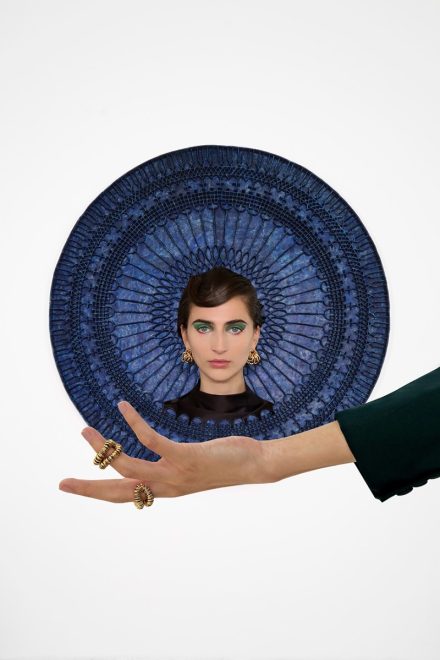
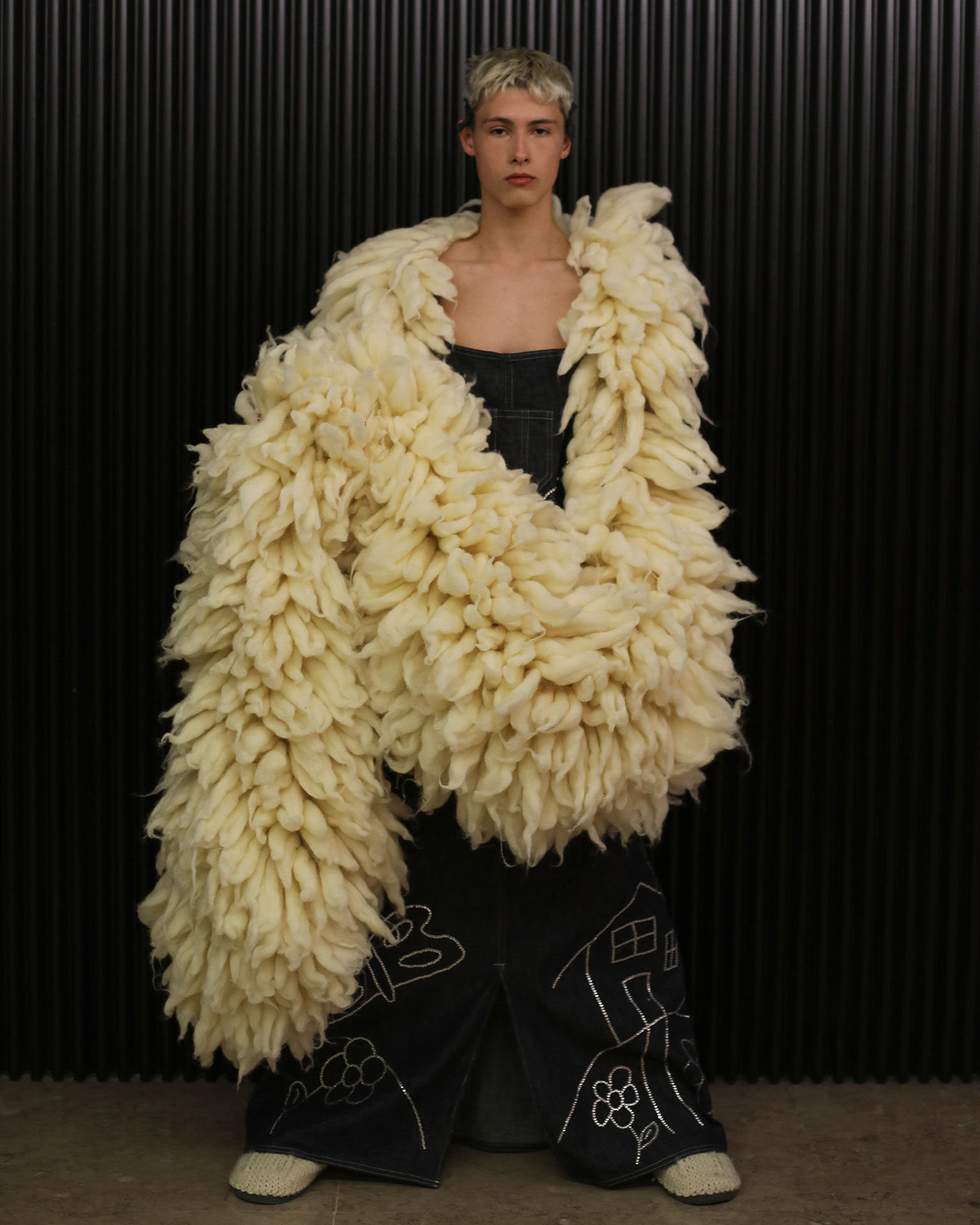
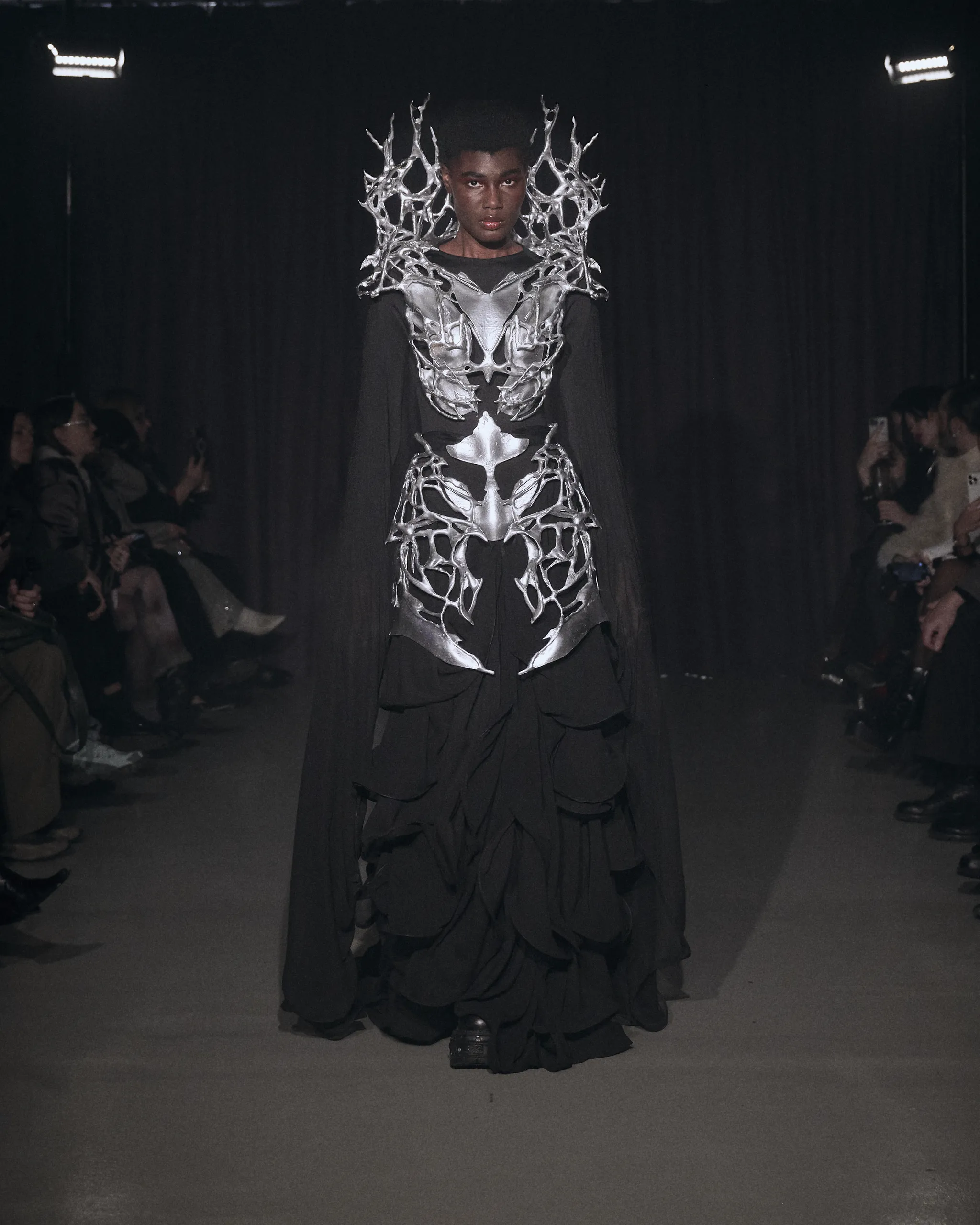
We went backstage at the MODAPORTUGAL showcase for emerging design to meet the latest cohort of top fashion graduates from Florence, London, Aalto, Paris and beyond.
At this year’s MODAPORTUGAL LINKS Fashion Design Competition, seven leading European fashion schools selected their top three students for an international graduate showcase in Porto, Portugal.
Representing Aalto University, Institut Français de la Mode, Polimoda, HEAD Genève, London College of Fashion, ESAD and Modatex, 18 young designers came together to present for a jury of leading fashion directors and creatives, who selected a winner from each school, and one overall. OE Magazine went backstage to check out the looks.
INSTITUT FRANÇAIS DE LA MODE, France
VICENTE AYCAGUER
Overall award and Jury award

Photography – Luís Miguel Fonseca
“SUSANNA VALENTI” is inspired by Casa Susanna, a private retreat in New York during the 1960s where men who lived publicly heteronormative lives would go to explore feminine dress. Drawing on the archive of photographs from the time – famously rediscovered at a flea-market – and subsequent documentary, Vicente Aycaguer’s collection celebrates the beauty of wardrobe in transition.
“In this collection, I explore how somebody socialized as a man reinterprets female dress: how he can make mistakes along the way; how he doesn’t really know how to wear these garments; and how at the end they all become a mix of one another, merging the classical male wardrobe and the female wardrobe.
The most interesting thing in the photos is not the garments, but the way they are worn. They’re from the interior of the house and it’s the 60s, so you have wallpapers, stripes – every pattern you can imagine. Styling, print and colour were very important. I wanted to bring that into my collection so that the whole line up bombards you with print and colour.”
PERU GOENAGA GOIKOETXEA


LEFT
Photography – Lena Hunter
RIGHT
Photography – Luís Miguel Fonseca
“SOMNIS (act)” weaves together two concepts: somnis, referring to the dreamlike geometric paintings of Pablo Palazuelo (Madrid, 1915-2007); and act, the action of integrating these artworks into real garments. Challenging himself to translate Palazuelo’s abstract shapes into patterns for 1980s-inspired functional garments, Peru Goenaga marries extreme materials with extreme methods.
“I’m really attracted to the aesthetics of Palazuelo’s work. It’s graphic, geometric, and in some way futuristic. He was inspired by philosophy, mathematics, physics and Oriental cultures, but the garments in my collection come from 80’s ski and outerwear, with very technical finishing, top stitches, herringbone, zippers – real utility. First, I dream: I sculpt with these abstract shapes. Then I act: I make real clothes. That dreaming-acting tension is the philosophical part of the collection.”
ZILAN MA


LEFT
Photography – PRETONUBRANCO
RIGHT
Photography – Lena Hunter
Zilan Ma‘s “NON-PLAYER” lives in the liminal static between Superliminal’s warped dimensions and Minecraft’s looping logic; a sartorial rebellion against the scripts we’re coded to repeat. Each garment exists as a visual paradox: structured yet fluid, minimal yet elaborate. Shapes deceive, textures collide, and silhouettes transform depending on the angle of view. Like Magritte’s This is Not a Pipe, these clothes whisper contradictions: this is real, this is not.
“I used to play this game called Superliminal, where everything is distorted based on where you’re standing. I used embroidery and printing techniques to mimic the graphics of those distorted effects, and laser cutting with a sublimation on top to create visual misposition. Surrealism has always been a big part of my design principles, and this collection is more like an art installation.”
HEAD GENÈVE, Switzerland
ALAA ALARADI
Jury award

Photography – Luís Miguel Fonseca
Alaa Alaradi‘s “FURTHER DEEPER SOFTER CLOSER” explores sculpture and fluidity via four materials: silk, leather, silver, and clay. The silks, all sourced from deadstock, are hand-dyed. The leather, also repurposed, is lined, patchworked, and malleable and can be sculpted into shape. The jewellery is first sculpted in wax and then cast in silver. Clay is used for ceramic hardware.
“It has a sculptural feel because everything is handmade. I think if you do something often enough and repeatedly you start to recognize your own signature. It’s almost subconscious in a way. That’s what I wanted to figure out. What is my language? What is my DNA? And I didn’t want to limit myself. I needed for it to be free and instinctive.”
HIPPOLYTE LAPORTE


TOP
Photography – Lena Hunter
BOTTOM
Photography – Luís Miguel Fonseca
Hippolyte Laporte’s menswear collection explores the tensions within contemporary masculinity, reinterpreting traditional bourgeois staples – tartan, the suit-and-tie, the polo – through transparency, lace, and couture-inspired cuts.
“It’s about masculinity and how I have felt pressured to dress a certain way. It’s about heteropatriarchy and how as straight people, queer people, we often need to disguise ourselves. All of my looks are composed of elements taken from bourgeois heteronormativity – mainly the attire of people in power. I also have a look inspired by a T-shirt, jacket, a kind of Chanel set. Putting it on a male body kind of subverts this idea of normativity and gender.”
XAVIER WEBER

Photography -Lena Hunter
Xavier Weber grew up in Grenoble, in the Alps, then on a small volcano called Nonette with his mother. With his father, he spent time in a small gypsy camp in the south of France. “WERCORS” gathers remembered fragments of childhood: objects, wardrobes, nature, family habits, the sports cars Xavier and his brothers fantasized about, and his deep attachment to rap music.
“All the materials and cuts are inspired by objects or habits in my family. Based on my father’s habit of rolling cigarettes, I developed a material out of rolling paper, silk and bioplastic. I also have a full mohair suit, knitted jacquard style, that looks like fake reindeer fur. I knitted a web and boiled it to look like spiderweb, based on a spider I saw on the volcano. I’m inspired by the things I saw in nature and childhood.”
AALTO UNIVERSITY, Finland
TILDA WALLIUS
Jury award


LEFT
Photography – Luís Miguel Fonseca
RIGHT
Photography – Lena Hunter
Tilda Wallius is a Helsinki-based designer working with discarded materials and sculpting garments directly on the body rather than following traditional patternmaking. “FINDERS KEEPERS” examines the quiet value of what people leave behind, encouraging a more attentive perspective on forgotten materials.
“It’s about the act of dumpster diving, which I do almost on a daily basis. If I have time, I go on these late-night walks and then I act like a raccoon. This collection started from the position of being poor in the fashion world. It feels very overwhelming because it’s very alienating. So I wanted to make the garments look and feel like artefacts instead of trash, with a focus on shapes that express the ill-fittingness of it all. Working with found materials is a nice restrictor in that sense because it keeps you brave, keeps you risky, keeps an open mind.”
EETU HEIKKINEN


Photography – Luís Miguel Fonseca
“HANG, FREEZE, CRASH” explores video game glitches and errors through silhouettes, internal structures and support layers inspired by Victorian clothing. Eetu Heikkinen‘s collection brings together advanced shape and pattern development with knitwear, print and weaving techniques, inhabiting a space between historical dress, physical reality and a malfunctioning metaverse.
“I’m interested in how glitches in video games visually affect objects, characters and the environment. You also get this weird visual effect when hardware deteriorates and consoles and computers die. Corrupted files and pixels dying on the screen create amazing patterns and bursts of colour. To bring this very modern digital research alive and visualize the glitches in clothing, I used Victorian fashion as a historical reference, mainly the corsets and the crinoline skirts. There are so many things to break in the Victorian silhouettes, and the tools are inside the clothes – like boning and wood.”
MARINE PUUMALA


Photography – Luís Miguel Fonseca
“I HAVE LOST MY MARBLES” is an experimental study of freedom, reality, identity and creativity, through the lens of women, madness and art. Marine Puumala engages with feminist theories by Judith Butler and Martha Nussbaum on objectification and gender performativity, and grounds the concept in Beauvoir’s existentialist reflections on autonomy.
“In art history, women were always the subject of a painting but not the artist. A woman could be accused of being hysterical for even having creative aspirations. It’s different now, but that history still influences our creative associations. This collection explores how madness can be a way to play yourself out of creative resistance. My visual research was a series of ten-minute trials with old fabric or garments where I would just try as many impulses as possible to forget the name of things, what an object or a garment is, how I’m supposed to interpret and relate to it. The donuts became symbolic for this way of abstracting because you dress the donut in the garment, and the body in the garment, or the body in the donut. There was this not-knowingness about whether the subject is the body, the person, or the donut.”
POLIMODA, Italy
NANSEN CAPICI
Jury award

Photography – Luís Miguel Fonseca
Nansen Capici‘s “SILENZIO BIANCO” is inspired by Arctic stillness, Inuit material intelligence and the focused rigor of architectural design studios, with references and stories drawn from family archive.
“This collection combines two themes that are close to my identity. The first is my dad’s side, a family of architects. It’s a very strict family, very composed, very formal, and I translated that to rigid research of shapes and silhouettes. The second theme is my own name – Nansen – which comes from a Norwegian late-1800s Arctic explorer. I connected to that through vintage ski- and sportswear, and references to Arctic landscapes. There is a silence at the core of the collection. It’s a cutting silence that makes you face your own self, your own identity, your own heritage, and makes you grow out of it in a personal way.“
AMINA VANNELING


Photography – Lena Hunter
Amina Vanneling emigrated from Iran to Sweden in 1999 and “QUIET ONE-SIDED RAIN – GOTHENBURG RAIN” is based on her earliest impressions of the Swedish city, its climate, and its people. Between 5pm and 8pm, the city often felt muted – locked in downpour and silence – and from her own quiet distance, Amina observed the atmosphere of strangers sharing space while remaining apart.
“My earliest impression of Gothenburg was the coldness of the rain – but that was a huge reflection on the people. We shared the streets, we shared the life, we shared the rain, but had no real human interaction with each other. You can imagine the cultural clash between that and Iran. My projects come out of building characters, their personas and responses to the world, based on my own photography. My main inspiration was Saul Lither, who made the most beautiful photography of people in the rain and through glass reflections in New York, in the ‘60s.”
J.T. PRINCE


Photography – Lena Hunter
“HOMECOMING” was born from a visit J.T. Prince made last summer to his grandparents’ farm in rural Idaho, a place where he spent his childhood summers helping his grandfather. During the trip, he experienced an immense feeling of nostalgia and melancholy, appreciating the beauty of his memories from the vantage-point of a changed individual. Using iconography and materials typically found in rural western communities, J.T. morphed these into new silhouettes and shapes placing them in a different context.
“This collection is inspired by specific aspects of life on my grandparents’ farm, whether it be the fields, fabric textures and types, or even funny furniture like plastic covered couches in my grandma’s house. I have a velvet skirt with plastic covering it, replicating that couch. It’s a playful incorporation of those personal nostalgic elements into new silhouettes and contexts.”
LONDON COLLEGE OF FASHION, United Kingdom
CALUM HOLMES
Jury award

Photography – Luís Miguel Fonseca
In his “PLANE CLOTHES” collection, Calum Holmes inserts a familial fascination with aviation into the context of clothing. His minimal approach to patterning mirrors the act of creating from a single sheet, reframing paper-plane folding methods as a luxury-garment-making technique. The one-piece construction is only apparent to those who take time to obsess over the details, just as the details of aeronautic engineering are only exciting to aviation nerds.
“Plane Clothes is about taking my family’s really nerdy wardrobe and elevating it with obsessive pattern cutting inspired by paper planes. I have an archetypal parka and a cargo skirt that I reworked in a playful way with these techniques. I wove a scarf from strips of jersey and did a graphic tee where, instead of printing the image, I wove the image into the t-shirt. And then the woven image came out and became the scarf.”
JANET QIU


Photography – Luís Miguel Fonseca
“HOTEL HETEROTOPIA” is a conceptual fashion project inspired by Michel Foucault’s notion of heterotopias – real places within a culture that function differently, mirroring and subverting the norms of their surrounding reality, like cemeteries, ships, prisons, or bars. Janet Qui‘s collection envisions eight fictional hotel guests, vessels of emotions from loneliness and obsession to envy and exuberance, each embodied in an outfit.
“The fictional hotel is inspired by American Horror Story. There’s a keeper of keys, which is the concierge of this hotel, and a devilish character prowling out of an old mattress. Another is a metaphor for jealousy with a corset and an exaggerated cage-like bone structure. The aesthetic is theoretical silhouettes, and I incorporated fabric I developed myself, like trained lace with liquid latex fused on it. In the hotel, fashion is a mirror and a weapon that reflects who we are and who we dare to be.”
MARTHA BIRD


LEFT
Photography – Mateus da Cunha
RIGHT
Photography – PRETONUBRANCO
Martha Bird’s “THE WARM-UP” reworks the aesthetics of antiquity, elegance and functionality from the ballet archive to extend the idea of costume restoration to ordinary wardrobes. She works with theatres and large businesses to source second-hand British textiles, and with local restaurants to repurpose food waste into naturally derived dyes.
“At the Royal Ballet in the UK, I worked lots of archives and costumes and became interested in how we could apply the sustainable ethics of costume restoration to our own wardrobes. I’m proud of my low-resource natural dyeing. Some colours took months to develop. I collected rusty iron from London and put it in rainwater, which can create a black dye. I used avocado from local restaurants, teabags from a local coffee shop, gallnuts which come from a tree, and lots of other different tree barks.”
MODATEX, Portugal
SÍLVIA DA TORRE
Jury award

Photography – Luís Miguel Fonseca
“SACRED” presents classic fashion codes outside their usual contexts, by applying experimental forms of textile manipulation and disrupting an earthy colour palette with bright pink. Sílvia Da Torre was inspired by site-specific land installation artists Christo and Jeanne-Claude.
UNIVERSITY OF LISBON, Portugal
MARIA MIGUEL BORDA

Photography -Lena Hunter
Maria Miguel Borda‘s “METAMORFOSE LÍRICA” is a sculptural collection that explores repetition as movement and transformation, inspired by nature and photography. Like a lens that freezes a gesture, the collection celebrates the ephemeral and the singular presence in time and space. Layers unfold like petals, volumes follow the movement of the body, and textures suggest continuous mutation.
“My collection is about movement and how complex structures in nature are born from simple elements. I used pleating so when you move, the piece moves with you, when you’re static, the piece stays static with you – like freezing the movement. I was really inspired by the photographer Philippe Halsman, who worked with Dali.”
ESAD, Portugal
ENZO PERES


LEFT
Photography – Luís Miguel Fonseca
RIGHT
Photography – PRETONUBRANCO
Enzo Peres‘ “HABIT(U)AR/DESABITU-AR” is to inhabit, to disinhabit, to habituate, and to unhabituate. The wordplay mimics the collection’s playful reconceptualization of military and workwear, integrating the colour pink.
Credits
WORDS
Lena Hunter
Photography
Luís Miguel Fonseca
Lena Hunter
Mateus da Cunha
PRETONUBRANCO