We spoke to Wirat Tengchiang, founder of avant-garde streetwear label TENWi, about his graduate collection and how his Thai heritage shapes his design approach
Most designers claim they were sketching gowns or styling Barbies before they even started school, but Thai-born, Austria-raised Wirat Tengchiang wasn’t one of them. Growing up in Vienna, he was far more interested in finding his rhythm on the football pitch than behind a sewing machine. It wasn’t until his teenage years that he began considering a career in fashion, sparked by formative moments such as customising his own football jerseys and Nike ID trainers online.
In 2016, Tengchiang started his BA in Fashion Design at the Fashion Institute Schloss Hetzendorf in his Austrian hometown. In the same year, he also founded his avant-garde streetwear label, TENWi — a portmanteau of his first and second names. Conceived to disrupt the fashion industry, the brand embodies the contrasts between South-East Asian spirituality and craftsmanship, couture, hip-hop culture, and non-binary forms.
His graduate collection, Reincarnation, embodies this philosophy. Drawing on core teachings from Theravada Buddhism, Thailand’s most dominant denomination, Tengchiang used these principles as a framework to source materials from unexpected places and transform them into a fully sustainable, unisex line. Since finishing fashion school last year, he has been dedicating his time to refining TENWi’s vision and working on creative direction projects with designers across Europe.
In this interview, Tengchiang reveals more about his environmentally and spiritually conscious approach, and how his cultural heritage continues to mould his raw yet refined aesthetic.


You founded TENWi during the first year of your BA Fashion Design course. Could you tell us more about the label’s early days and ethos?
I didn’t grow up imagining myself in fashion. Creativity was always around me, but it took time to realise it was my language. I think, if anything, design chose me. At some point, I had all of these visions — flashes of colour, texture, energy — and I felt compelled to bring them into existence. That’s what led me to fashion school, to immerse myself in the world of creatives, and ultimately, to found my brand.
I was curious about how streetwear could exist in a high-fashion context. TENWi began as an experiment to answer that question, merging the everyday with the exceptional. I wanted to dissolve the lines of traditional binary aesthetics, creating a sublime mélange of masculinity and femininity. TENWi isn’t just about clothing; it’s a reaction against outdated notions of gender and identity.
Growing up between two countries with strikingly different cultures and fashion scenes, how has that contrast shaped your style identity?
We moved to Vienna when I was three, so in many ways I consider myself ‘Austrian’ — from the language I speak with my friends to the cultural references I absorb daily. I’d say the streetwear elements in my work stem largely from Western influences, such as hip-hop music, and from being immersed in sport from a young age, playing football. But my Thai roots are always present.
Before the pandemic, I would often visit my other hometown, Phuket. It’s a place where I can slow down, reconnect with myself, and recharge. The textures, colours, and rituals of Thai culture continually inspire me, and I often weave these traditional details into my designs. But it’s never simply for decorative purposes — it’s more a dialogue with heritage, a way of honouring where I come from while translating it through my own creative lens.


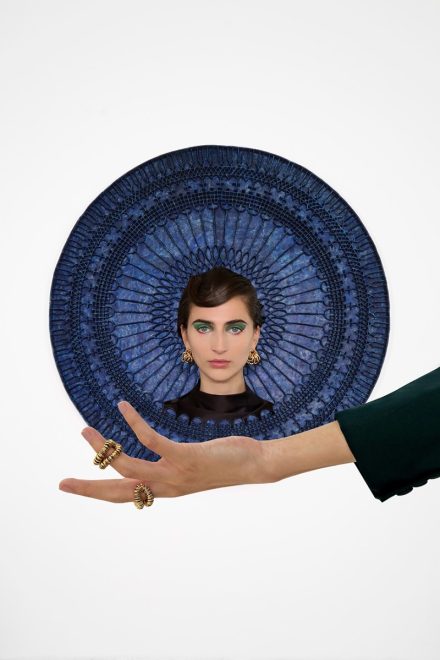
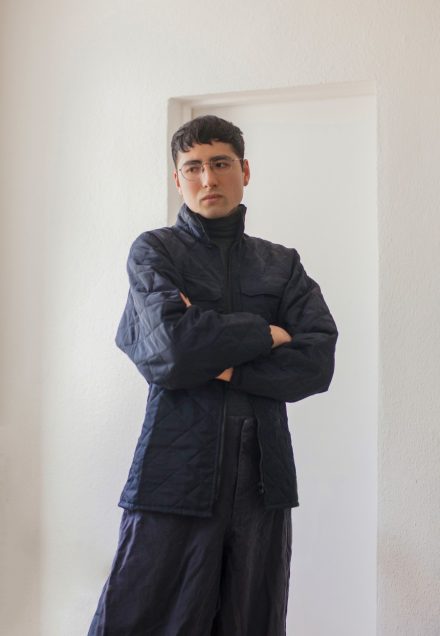
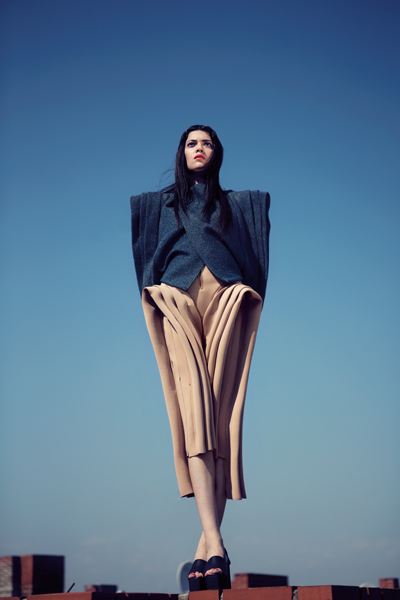
From the accompanying editorial images, it’s clear that your graduate collection, Reincarnation, reflects your commitment to honouring your Thai heritage. What was the concept behind the collection?
Reincarnation is rooted in the idea of spiritual and material rebirth. The collection draws on my research into Theravada Buddhism and its influence on art, fashion, and subcultures. I wanted to show that spirituality and sustainability aren’t opposing forces; they can coexist in harmony.
Thai culture carries a deep respect for what already exists. Every piece in the collection was made from repurposed materials — truck tarpaulins, rice sacks, old tablecloths, and vintage textiles. I hoped to inspire younger generations to create with intention, sourcing fabrics from unexpected or overlooked places.
Beyond exploring and celebrating my cultural heritage, this project was developed as part of the ActNow Fashion Challenge by the United Nations (UN). Launched in 2015, the UN’s 17 Sustainable Development Goals aim to guide the world toward a more conscious future. Reincarnation aligns with the twelfth goal, Responsible Consumption and Production, encouraging the efficient and sustainable use of resources.
Why did you decide to take part in the UN’s ActNow Fashion Challenge?
In 2019, during the penultimate year of my BA Fashion Design course, one of my tutors told me about the challenge. I was actually the only student in my class to sign up. I saw it as an opportunity to push myself — to create something entirely zero-waste. I was particularly drawn to the idea of finding beauty through responsibility, and meaning through making.
Alongside the collection, my thesis explored sustainable fashion practices, with a special focus on upcycling and material innovation. On reflection, this became far more than a one-off project; it was a commitment to transformation. Even after completing the challenge, I’ve continued to inject this mission into every aspect of my creative work.


Each piece in this collection feels deeply layered, intricate, and emotionally charged — as though it has its own story waiting to be told. What inspired this maximalist approach?
(Tengchiang laughs.) It’s funny you picked up on that! At fashion school, my tutors often referred to me a ‘maximalist’ because I tried to pour every emotion I had into every single piece. Sometimes it felt like a critique — something I should tone down or be wary of — but very early on, I decided I didn’t want to change my natural approach. That’s simply how I process the world: through excess, through contrast, through beautiful chaos.
I’m not chasing trends or references; I’m building my own visual language. TENWi has to be an honest reflection of who I am — how could I possibly connect with others if I’m not first connected to myself? If anything, I’ve leaned into the ‘maximalist’ label and learned to embrace it as a defining feature of my work.
Beyond this collection, what role does spirituality play in your creative process?
A massive one. As I mentioned, Reincarnation was heavily inspired by Theravada Buddhism — its focus on mindfulness, impermanence, and renewal. But values derived from Buddhism influence all aspects of my design process, and even my life more generally.
I see Buddhism less as a religion and more as a philosophy — a way of understanding life and creativity. Even people who aren’t religious can relate to the concept of rebirth. For me, sustainability is also spiritual. It’s about awareness, respect, and balance. To design consciously is, in a sense, an act of meditation.


As an environmentally conscious designer, what changes would you like to see in the fashion industry?
Fashion has such a rich legacy — it deserves care, not consumption. So most importantly, I think the industry needs to slow down. As consumers or designers, we need to buy and create with intention, learning to treat clothes not as disposable trends, but as extensions of human stories. The future of fashion depends on how deeply we understand this.
Fashion should be an act of awareness — of who we are, what we consume, and what we leave behind. In order to live more sustainably, we all need to become more mindful of the choices we make. Clothing should reflect the people creating them, the environment, and our artistic heritage. The future of the fashion industry is our responsibility, and we must support this idea to create better conditions for generations to come.
Looking towards the future, what’s next in store for TENWi?
Right now, I’m not rushing to produce seasonal drops. Instead, I’ve been experimenting with new upcycling concepts for TENWi’s first capsule collection and connecting with local studios for potential collaborations. I’m also making a conscious effort to use social media to be more vocal about sustainability — it’s important to use that platform to educate and provoke thought. TENWi’s official website will be launching soon, which I’m certain will take up a lot of my time (Tengchiang laughs).
Outside of the brand, I work as a creative director and stylist. I’ve been intentionally focusing on smaller, collaborative projects with designers and creatives who share similar values. Recently, I directed and shot a lookbook and fashion film with local artists, which we plan to release soon. After that, I’ll just have to see where my path takes me.


Credits
WORDS
Lucy Rowan
Fashion
TENWi by
Wirat Tengchiang
Photography and Creative Direction Matthias Leidinger
Hair and
Make-uP
Anabella Pajic
Models
Wirat Tengchiang
and Anabella Pajic
Shoes and
Studio
Burggasse 24